
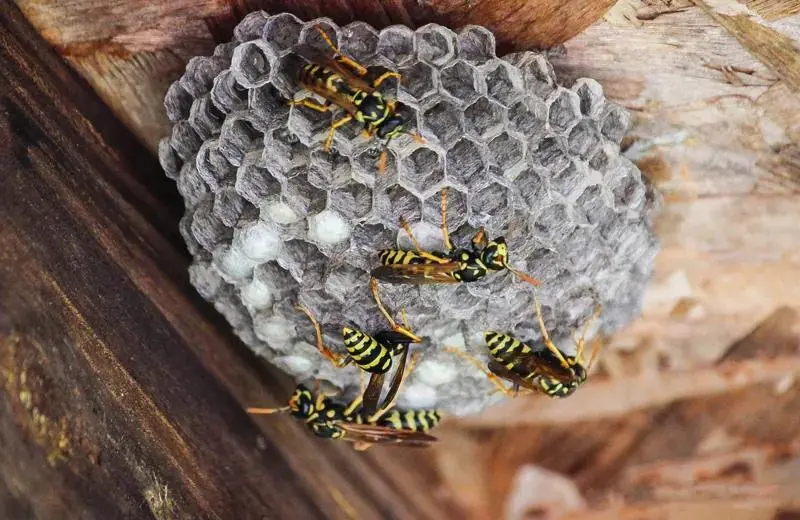
As the summer heat intensifies across the Greater Toronto Area, wasp activity spikes dramatically. From early July through September, queen wasps expand their colonies, turning small, unnoticed paper cells into aggressive nests containing thousands of workers.
For homeowners and business operators in Toronto, Brampton, and Mississauga, wasp encounters present more than just a nuisance—they are a direct safety risk. This comprehensive guide covers everything you need to know about identifying local species, navigating Ontario pest regulations, managing dangerous wall void infestations, and choosing a safe, professional removal solution.
Who do I call to remove a wasp nest safely in the GTA?
You must call a licensed structural pest control company to safely remove a wasp nest from your property. Municipal services (like animal control or the fire department) do not remove wasp nests from private property unless they pose an immediate, life-threatening emergency in a public space.
Structural pest control providers (such as the licensed exterminators at Pestisect Toronto) possess the commercial-grade protective gear, extension equipment, and specialized micro-dust formulations required to eliminate a colony safely. Calling a professional protects you from the severe swarm attacks that commonly result from DIY knock-down attempts.
How much does professional wasp nest removal cost in Ontario?
The cost of professional wasp nest removal in Ontario ranges from $150 to $350 for standard, visible nests, and $250 to $500+ for hidden wall void treatments or high-altitude nests requiring specialized scaffolding. The final price depends on accessibility, nest height, and the treatment method.
To help you budget, here is a detailed breakdown of average structural wasp removal costs in the Greater Toronto Area:
| Nest Type & Location | Typical Price Range | What It Includes |
|---|---|---|
| Standard Visible Nest (Ground level, under 10 ft, e.g., deck or porch) | $150 – $220 | Direct treatment + physical nest removal. |
| High-Altitude Nest (Roof peaks, soffits, tree branches above 15 ft) | $220 – $350 | Extension pole dusters + ladder work. |
| Wall Void / Siding Nest (Hidden behind brick, stone, or siding) | $250 – $400 | Pressurized aerosol/dust injection + warranty. |
| Emergency/After-Hours Service (Same-day dispatch, high sting risk) | $300 – $500 | Priority dispatch within 2-4 hours. |
What is the fastest way to get rid of a yellowjacket nest in a brick wall void?
The fastest and safest way to eliminate a yellowjacket nest in a wall void is to inject a pressurized insecticidal dust (like permethrin) directly into the entry hole. Do not seal or caulk the entry crack; doing so traps the wasps, forcing them to chew through interior drywall into your living space.
When yellowjackets build a nest inside a wall void (often entering through brick weep holes or gaps in window siding), standard liquid aerosols fail because they cannot reach the heart of the paper comb. Pressurized micro-dust coats the entering and exiting worker wasps. These workers carry the dust deep inside the wall via the “transfer effect,” killing the queen and larvae within 24 to 48 hours.
Professional Exclusion:
Steel Reinforcement:
Electrical Inspection:
Is the landlord or tenant responsible for wasp removal in Ontario?
Under Section 20 of the Ontario Residential Tenancies Act (RTA), the landlord is solely responsible for maintaining the rental property in a good state of repair and fit for habitation, which includes professional pest control. Tenants are responsible for keeping their unit clean but do not have to pay for wasp removal.
If a tenant discovers a wasp nest on a balcony, under a window, or inside a wall, they should immediately submit a written maintenance request to the landlord. If the landlord fails to hire a licensed exterminator in a timely manner, the tenant can file a T6 application (Tenant Application about Maintenance) with the Ontario Landlord and Tenant Board (LTB) to seek a rent abatement or reimbursement for pest control costs.
Can I spray a wasp nest at night with store-bought aerosol?
No. While wasps are less active at night, attempting to spray a nest yourself with store-bought liquid spray is highly dangerous. Liquid sprays cause instant panic in the colony, triggering defensive swarm attacks in the dark where your visibility is limited.
Furthermore, retail aerosol sprays have zero residual effect. If you miss even a small fraction of the colony, the surviving wasps will rebuild the nest within days and remain highly aggressive. Professionals wear thick, protective structural suits and inject dry dusts, which do not provoke the same immediate swarming reflex as cold liquid sprays.
How do exterminators find a hidden wasp nest in siding or brick?
Exterminators locate hidden wall nests by observing flight patterns (“wasp highways”), checking thermal heat signatures with infrared cameras, and listening for rhythmic scraping sounds behind drywall. Once the precise void is identified, treatment is applied directly through the entry point.
Yellowjackets are creatures of habit. During peak daylight hours (11:00 AM to 3:00 PM), workers enter and exit the entry gap every few seconds. Our technicians monitor these pathways to locate the nest’s access point. In complex cases, thermal imaging allows us to see the heat generated by the colony’s vibration inside the drywall without drilling exploratory holes.
What is the difference between a wasp nest and a hornet nest?
Wasp nests (specifically paper wasps) are open-faced combs with visible hexagonal cells resembling a honeycomb, usually built in sheltered spots. Hornet nests (and yellowjacket nests) are fully enclosed in a thick, grey, paper-like envelope with a single small entrance hole at the bottom.
While both are made of chewed wood mixed with wasp saliva, hornet nests are significantly larger (often the size of a football or basketball) and contain thousands of highly aggressive workers. Paper wasp nests rarely exceed 100 workers and are far less defensive.
Will wasps return to the same nest next year?
No. In Ontario, wasp colonies die off completely in late autumn due to freezing temperatures. Only fertilized new queens survive by hibernating under tree bark or in attic insulation. The old paper nest degrades and is never reused by a new colony.
However, if a location is highly attractive (e.g., a specific soffit gap or brick weep hole), a new queen may choose to build a brand-new nest in the exact same spot next spring. This is why professional exclusion work—such as installing wire weep hole covers and caulking structural gaps—is critical once the colony is eradicated.
What should I do if I am stung by a wasp in Ontario?
Are paper wasps beneficial or just pests?
Paper wasps are beneficial insects in the local Ontario ecosystem because they are natural predators of garden pests like caterpillars, beetles, and flies. However, when they nest close to doorways, patios, or play areas, their sting risk outweighs their ecological benefit, requiring removal.
If a paper wasp nest is located far away from human activity (such as at the back of a large property), it can be left alone. If it is located on a deck railing or near an entrance, it poses a safety hazard and should be handled by a professional.
Ontario Regulatory & Compliance Framework (EEAT)
Extermination in Ontario is governed by strict environmental and safety laws.Homeowners must understand these regulations to ensure their property remainscompliant and safe.
The Ontario Pesticides Act
PMRA Registration
Municipal Property Standards
In the GTA, landlords must keep buildings free from pest infestations under local property standards bylaws:
- Toronto: Toronto Municipal Code Chapter 629 (Property Standards) dictates that all properties must be kept free of pests, vermin, and conditions that attract them.
- Brampton: Brampton Property Standards Bylaw 104-2026 requires immediate extermination of pest hazards on residential properties.
- Mississauga: Mississauga Property Standards Bylaw 0210-2026 enforces similar rules, giving code enforcement officers the power to fine property owners who ignore dangerous nests.
The Professional Wasp Treatment Protocol
Step 1: Inspection & Identification
Step 2: Custom Treatment Plan
Step 3: Pressurized Dust Injection
Step 4: The Transfer Effect
Step 5: Exclusion & Prevention
Wasp Season Prevention Checklist
- Seal Weep Holes: Install stainless steel mesh weep hole covers. These allow bricks to breathe but stop yellowjackets from entering wall voids.Seal Weep Holes: Install stainless steel mesh weep hole covers. These allow bricks to breathe but stop yellowjackets from entering wall voids.
- Inspect Soffits and Fascia: Check for gaps along your roofline. Seal any openings with exterior-grade silicone caulk.Inspect Soffits and Fascia: Check for gaps along your roofline. Seal any openings with exterior-grade silicone caulk.
- Manage Outdoor Waste: Ensure all garbage cans and compost bins have tight-fitting lids. Wasps are highly attracted to sweet liquids and high-protein foods in mid-summer.Manage Outdoor Waste: Ensure all garbage cans and compost bins have tight-fitting lids. Wasps are highly attracted to sweet liquids and high-protein foods in mid-summer.
- Remove Fruit Fall: If you have fruit trees (apples, pears, cherries) on your property, clean up fallen fruit immediately, as decaying sugars attract massive yellowjacket swarms.Remove Fruit Fall: If you have fruit trees (apples, pears, cherries) on your property, clean up fallen fruit immediately, as decaying sugars attract massive yellowjacket swarms.
- Hang Fake Nests: Some territorial species (like paper wasps) will avoid building a nest within 20 feet of an existing colony. Hanging a decoy lantern-style nest early in spring can deter them.Hang Fake Nests: Some territorial species (like paper wasps) will avoid building a nest within 20 feet of an existing colony. Hanging a decoy lantern-style nest early in spring can deter them.